
A focused Green Financing Workshop was successfully conducted today in Panipat under the EU Switch Asia – Green Threads Project, in collaboration with the Young Entrepreneurs Society (YES), Panipat, which represents a strong network of 152 MSMEs and exporters from the textile and home furnishing sector.
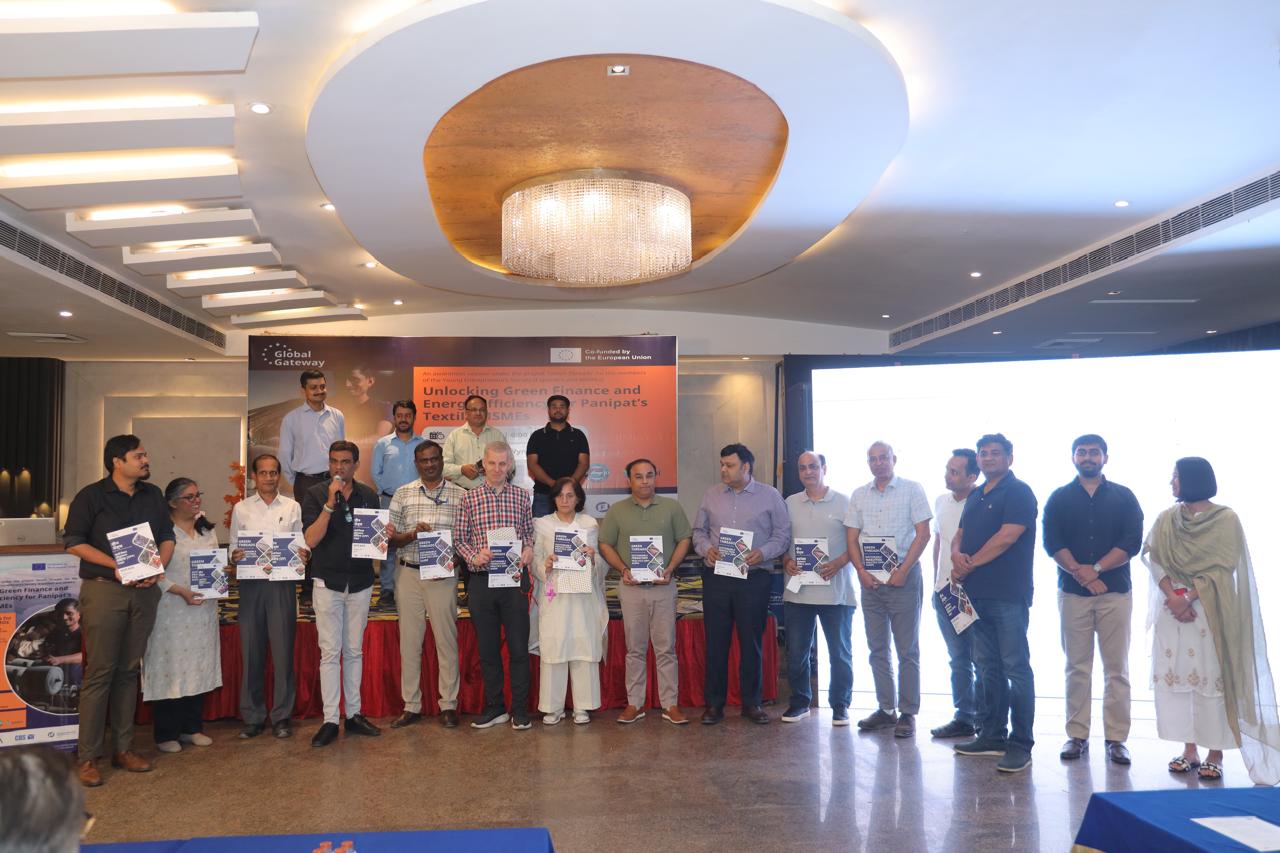 |
FMC, YES leaders & dignitaries unite to drive Panipat MSMEs towards global sustainability growth
The workshop aimed at building awareness and facilitating access to green financing solutions, while also sensitizing MSMEs on evolving sustainability requirements in global markets, particularly the European Union.
The session was organised by the Foundation for MSME Clusters (FMC) along with its consortium partners Copenhagen Business School and SIDBI, bringing together key stakeholders including representatives from the Bureau of Energy Efficiency (BEE), Small Industries Development Bank of India (SIDBI), and the Haryana MSME Department.
The event opened with remarks from Mr. Rajat Grover, President, YES, who emphasised the urgency for MSMEs to align with global sustainability norms.
A significant focus of the session was on SIDBI’s green financing products, including SPICE, EDGE, Working Capital, Machinery Loans, Sthapan, and EV financing, which are designed to support MSMEs in adopting sustainable practices. Participants were also introduced to the BEE ADEETIE Scheme, which promotes energy efficiency investments.
In addition, officials from the Haryana Government shared insights on various state-level support mechanisms under the Haryana Enterprise & Employment Policy (HEEP), including Freight Assistance, Market Development Assistance (MDA), Testing Equipment support, Quality Certification, Stamp Duty reimbursement, and Electricity Duty exemption. The session also covered benefits under the Haryana Textile Policy and the PADMA Scheme for pollution abatement in textile dyeing units.
As a key highlight of the workshop, Sustainable Production Manuals specifically developed for the Panipat Textile Recycling Cluster were officially launched. In addition, a Digital Product Passport (DPP) pilot programme was also launched, with support from Green Story, to enhance data readiness and traceability of textile waste within the Panipat cluster.
The workshop also linked these financial and policy interventions with upcoming European Union regulations, including the Ecodesign for Sustainable Products Regulation (ESPR), Extended Producer Responsibility (EPR), and Waste Shipment Regulation (WSR). Participants were sensitized on the growing importance of traceability, circularity, and compliance, including emerging requirements such as the Digital Product Passport (DPP).
Industry leaders from the Young Entrepreneurs Society (YES), including Mr. Rajat Grover, President, and Mr. Raman Chhabra, Ex-President along with YES Members, were present and expressed strong commitment towards enabling Panipat’s MSMEs to transition towards sustainable and globally competitive business practices.
Dignitaries Present
The workshop was graced by the presence of:
Mr P. Shyam Sundar, Director, Bureau of Energy Efficiency (BEE)
Mr Vikas Jangra, Joint Director, Haryana MSME Department
Ms Sonica Chabra, Assistant General Manager, Small Industries Development Bank of India (SIDBI)
Mr Peter Lund Thomsen, Professor, Copenhagen Business School, Denmark
Ms Uzma, Assistant Professor, Copenhagen Business School, Denmark
Ms Devyani Hari, Senior Director, Center for Responsible Business
Their participation underscored the strong institutional support available for MSMEs in their transition towards sustainable and compliant business practices.
The workshop witnessed active participation, with MSMEs showing keen interest in accessing financing support, undertaking energy efficiency improvements, and aligning with global sustainability standards.
The event concluded with a vote of thanks by Mr. Abhishek Naga, Deputy General Manager (FMC), who appreciated the active participation and reaffirmed FMC’s commitment to supporting the textile ecosystem on its sustainability and compliance journey.
The Green Threads Project, supported by the EU SWITCH-Asia Programme, aims to accelerate the transition of India’s textile and apparel sector toward more sustainable, circular, and resource-efficient production practices. As global markets—especially the European Union—tighten sustainability regulations, MSMEs face rising pressure to demonstrate compliance, transparency, and environmental responsibility across their supply chains.
The project focuses on capacity building, policy dialogue, awareness creation, and technical support for MSMEs to help them:
Understand upcoming EU regulations such as ESPR, DPPs, and WSR
Improve circularity practices, waste management, and product design
Strengthen competitiveness in global markets
Build long-term resilience through sustainable business models
The Foundation for MSME Clusters (FMC) is implementing the project in India to ensure that MSME clusters—especially in textile hubs like Panipat and Amroha—are not left behind in the global shift toward greener manufacturing. FMC’s involvement reflects its long-standing commitment to helping MSMEs adopt better practices, access new opportunities, and remain globally competitive.
About FMC
Foundation for MSME Clusters (FMC), a leading non-governmental, not-for-profit public charitable trust, established in India in 2005. FMC has made remarkable strides in fostering sustainable livelihoods and environmental progress through our innovative cluster development approach. Our work spans more than 300 MSME clusters, supporting over 100,000 artisanal and industrial units, ranging from household operations to medium-sized production entities. As an empanelled Nodal Agency with the Ministries of MSMEs and Rural Development, FMC extends support to prominent schemes like SFURTI, and is also providing technical, research, and evaluation support to various organizations such as SIDBI & KVIC. FMC has implemented multiple projects on environment and livelihoods with support from agencies like NABARD, UNIDO, UNDP, EU, ADB, and major corporates such as Cisco, Mahindra Finance, HCL, Yes Bank, and Hindalco.