
For years, the narrative of luxury housing in India has been defined by an aspirational drift toward metropolitan skylines. That axis is now reversing. Tier 2 cities are no longer only shedding their status of being merely ‘emerging’ to reveal themselves to be self-sustaining ecosystems of high aspirations where luxury is no longer merely an import, but an inherent attribute of their very fabric.
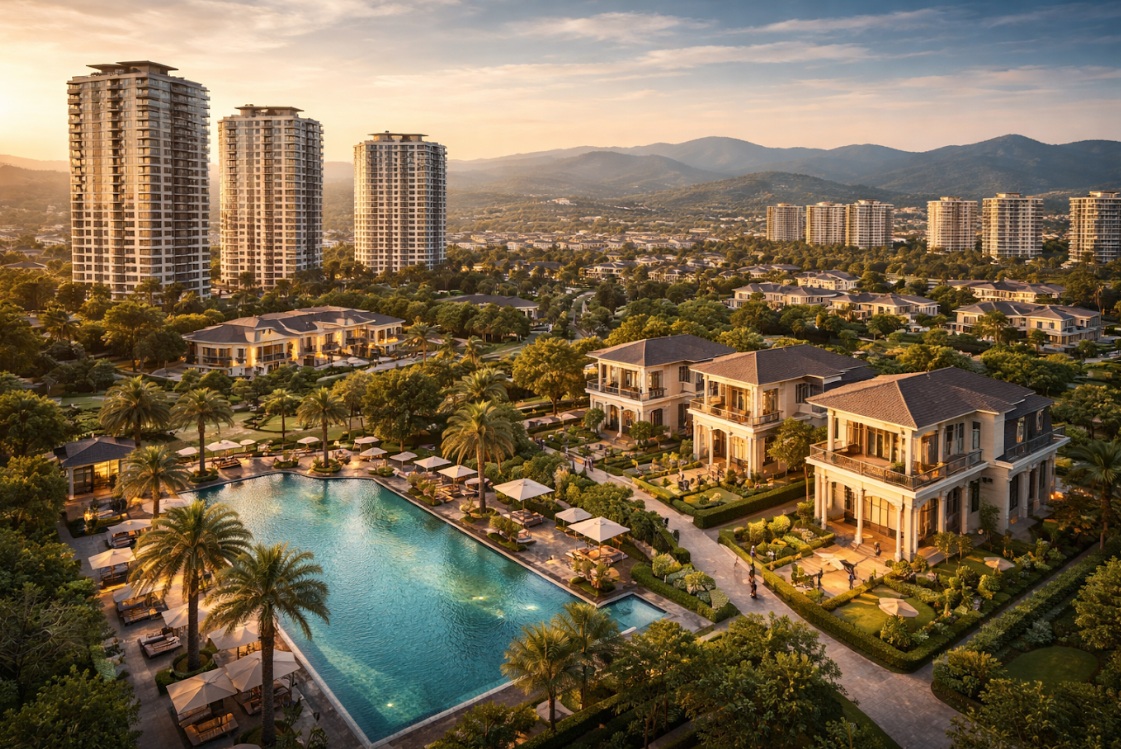 |
Luxury living takes root in emerging cities, where modern residences, green spaces, and community-driven design reflect evolving aspirations and local prosperity
The fulcrum has shifted from salary-driven wealth to enterprise-driven prosperity, with family-owned businesses reaching unprecedented heights, startup success achieving significant exits, and SME and industrial clusters increasing their economic footprint in non-metro regions. No longer confined to a handful of urban centers, wealth in India is now far more dispersed geographically. This change in the distribution of wealth is having a significant impact not just on wealth itself but also on consumption. Today, there is a growing trend towards wealth being spent in the place in which it is created. This is in stark contrast to metros, where there may be a portfolio approach to wealth.
According to Anarock, premium and luxury homes now account for a significantly higher share of new residential launches in several tier 2 cities, showcasing how developers’ confidence in sustained end-user demand in these markets. The contours of wealth creation in these parts are also shifting with enterprise-led growth steadily overtaking traditional salary-driven accumulation. Across Tier 2 cities, family-run businesses are scaling with renewed ambition, startup ecosystems are unlocking meaningful value through exits, and SME as well as industrial clusters are deepening their economic influence.
Besides, a defining aspect of this shift is the clear dominance of the end user. In Tier 2 cities, demand is led by business families upgrading primary homes, next-generation buyers raising lifestyle benchmarks, and NRIs returning with global exposure yet strong local ties. Unlike metros, where luxury often aligns with investment logic and second homes, here it is rooted in end use. The focus is on high-conviction homeownership: consumption-backed, deeply personal, and centred on creating residences that serve as both lifestyle upgrades and long-term legacy assets.
Umang Jindal, CEO, Homeland Group, said, “In markets like Mohali and Chandigarh, we are witnessing how luxury is being defined and consumed. The demand is not being driven by external capital but by deeply rooted, local wealth. Entrepreneurs, industrialists, and globally exposed professionals are choosing to elevate their living standards without relocating. What is particularly noteworthy is the clarity of intent among buyers; they are not experimenting with luxury; they are committing to it. This is translating into a preference for expansive layouts, gated villa communities, and low-density developments that offer both privacy and permanence. It reflects a market that is maturing with quiet confidence.”
Preksha Singh, CEO, Agrasheel Infratech, added, “In cities like Lucknow, the premium housing market is evolving in a way that feels both organic and inevitable. As the city’s economic base strengthens and new-age businesses take root, we are seeing a generation of buyers that is far more design-aware and lifestyle-conscious than before. Luxury here is no longer about scale alone, but about refinement, detailing, and a sense of arrival within one’s own city. There is also a strong emotional dimension at play, where families are choosing to build legacy homes rather than migrate. This is creating sustained, end-user-driven demand that is far more stable and deeply anchored.”
Ashwinder R. Singh, Chairman, CII Real Estate Committee; Vice Chairman, BCD Group; Advisor, NAR-India said, “This is not a shift of luxury. It is a shift of confidence. For the first time, the Indian homebuyer is choosing not to migrate, but to upgrade where he already lives. Tier 2 cities are no longer catching up with metros; they are developing their own consumption identity. What defines luxury here is not price, it is intent. Larger homes, better design, and institutional-grade developments are now being demanded in markets that were once driven purely by necessity. This is not spillover demand. It is native aspiration, powered by local wealth creation, infrastructure, and digital exposure. For developers, the implication is clear: this is not a scale play, it is a credibility test. Because in this cycle, trust will travel faster than brand.”
Moreover, land is emerging as a key component of the Tier 2 growth story, particularly in peripheral pockets where initial growth is resulting in tangible price appreciation. Developers are entering these markets from a long-term perspective, recognizing land as a play on future growth rather than just a component of inventory. Much of this activity is unfolding alongside new infrastructure, but the demand itself isn’t being created by these developments. It already exists, rooted in local ambition and rising affluence. What infrastructure does is bring that confidence to the surface, giving it direction and legitimacy rather than driving it from scratch.
Kushagr Ansal, Director, Ansal Housing, said, “Across Tier 2 cities, the shift towards luxury housing is not an isolated phenomenon but part of a broader structural evolution. As economic activity becomes more distributed, so does aspiration. What we are observing is a move away from speculative real estate cycles towards consumption-led growth, where buyers are investing in homes they intend to live in and hold over generations. Infrastructure development is certainly accelerating this transition, but the underlying driver is rising affluence and confidence within these cities. For developers, this calls for a more nuanced approach that prioritises quality, community, and long-term value creation over scale.”
Harvinder Singh Sikka, Chairman, Sikka Group, said, “In North India, Dehradun presents a unique intersection of natural appeal and evolving urban aspiration, which is increasingly reflected in its housing choices. Buyers here are seeking more than just a residence; they are looking for a lifestyle that blends openness, wellness, and exclusivity. This has led to a growing preference for boutique luxury developments and villa formats that offer a sense of retreat without disconnecting from the city. Interestingly, a significant portion of this demand is coming from within the region itself, including business families and returning professionals. It signals a shift where luxury is being internalized rather than imported.”
What is unfolding across Tier 2 cities is less a phase and more a fundamental rebalancing of India’s housing narrative. Luxury housing is becoming more evenly anchored, shaped by multiple cities with their own economic and cultural momentum. In that sense, this is not simply decentralisation, but a repositioning of priorities.